Chapter III
The Storm
The barometer had been falling all day. Thomas watched it with the attentiveness of a man who had learned to read the sea's moods. By late afternoon, the pressure had dropped so low that he knew a significant storm was approaching. The sky confirmed it—bruised clouds rolling in from the north, and the sea taking on that peculiar oily quality that preceded violence.
He spent the remaining daylight hours securing everything that could be secured. The cottage shutters were latched, loose equipment stowed, extra fuel brought up to the lamp room. The light must not fail, regardless of what the storm brought.
As darkness fell, the wind arrived. It came not gradually but all at once, as if some great door had been flung open. The lighthouse shuddered under the assault, and Thomas felt the vibration through the soles of his boots as he worked to keep the lamp burning.
Rain followed, driven horizontally by the gale, hammering against the glass of the lamp room with such force that Thomas feared it might shatter. But the lighthouse had weathered countless storms before this one. The glass held.
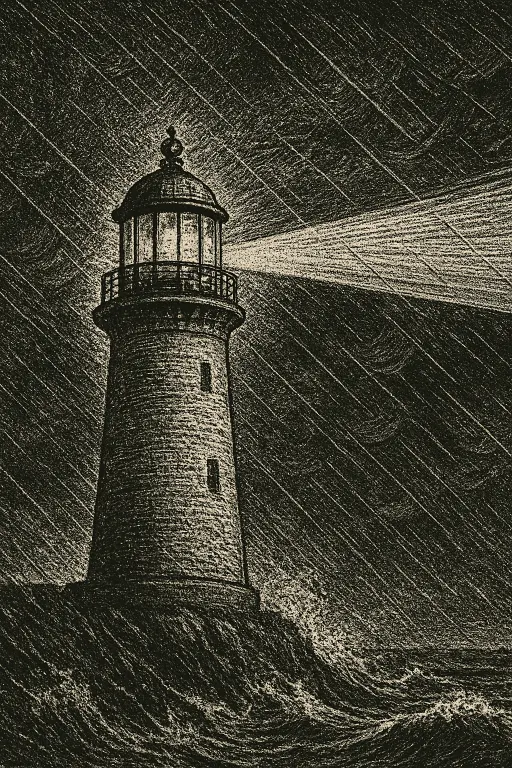
Through the tempest, the beam continued its steady rotation, cutting through the chaos with mechanical indifference. Thomas found something comforting in that constancy. Outside, the world had dissolved into wind and rain and darkness. But here, in this room of glass and light, order persisted.
It was near midnight when he heard the voices.
At first, he thought it was merely the wind—the storm finding its way through cracks and crevices, creating sounds that mimicked human speech. But as he listened, he realized there was structure to the sounds. Words. Names. His own among them.
"Thomas Wren."
The voice was clear despite the storm's roar. It seemed to come from just outside the lamp room, as if someone stood on the gallery that circled the lighthouse at this height. But that was impossible. No one could survive out there in this weather.
He moved to the window, pressed his face against the rain-lashed glass. The beam swept past, illuminating nothing but storm and spray. And then, in the brief moment before darkness returned, he saw them.
Figures, standing on the gallery. Translucent, barely visible, but undeniably there. Seven of them, dressed in the rough clothing of lighthouse keepers from different eras. They stood facing inward, looking at him through the glass with expressions he could not read.
Thomas stepped back, his heart hammering. This was madness. Hallucination brought on by stress and isolation. The mind playing tricks, just as it had for the keepers before him. He closed his eyes, counted to ten, and looked again.
They were still there. And now one of them—the figure nearest the door—was pointing downward, toward the base of the lighthouse.
Against every instinct, Thomas opened the door to the gallery. The wind nearly tore it from his hands. Rain and spray lashed his face, stealing his breath. But the figures remained visible, clearer now that nothing separated them. They were not hostile, he realized. They were warning him.
He followed the pointing finger's direction, looking down through the storm toward the rocks below. At first he saw nothing but waves and foam. Then a flash of lightning illuminated the scene, and Thomas understood.
A ship. A fishing vessel, battered by the storm, was foundering on the rocks at the island's eastern shore. He could see figures clinging to the rigging, could imagine their terror as the ship broke apart beneath them.
The lighthouse beam swept over them every thirty seconds, but they were too close to shore, too low in the water. The captain might not see them in time to render aid. They would drown within sight of the light that was meant to save them.
Thomas pulled himself back into the lamp room, his mind racing. There was a signal rocket in the supply cabinet—he had seen it during his initial inventory. If he fired it, ships further out to sea might see, might come to investigate. It was a slim chance, but it was all he had.
He grabbed the rocket, returned to the gallery. The ghostly keepers had not moved. As he prepared the rocket, he felt their presence not as threat but as fellowship. They had all stood this watch. They had all faced this terrible responsibility.
The rocket blazed upward, its red light cutting through the storm like a wound in the sky. Once. Twice. Three times Thomas fired, until his supply was exhausted. Then he could only wait, and watch, and pray that someone had seen.
An hour passed. Then two. The storm showed no sign of abating. The ship was breaking up, its hull grinding against the rocks. Thomas had begun to lose hope when he saw lights approaching from the south—a larger vessel, perhaps drawn by his distress signals.
Through the rain and spray, he watched as the rescue played out. Boats lowered, men pulled from the water, the desperate scramble against wind and wave. And when the last soul had been pulled from the wreckage, when the rescue ship turned away from the island and back toward the safety of the harbor, Thomas felt something release inside his chest.
He looked for the ghostly keepers, but they were gone. Only the storm remained, already beginning to weaken as it moved inland.
In the lamp room, Thomas made an entry in the log, his handwriting shaky from cold and exhaustion.
Storm. Ship foundered on eastern rocks. Signal rockets fired. Rescue effected. All souls saved. The light did not fail.
He added one more line, knowing how it would sound to anyone who read it, but writing it anyway because it was true.
I was not alone tonight.